

Blue Book

Anyone connected to the Wake Island civilian contractors’ story either has or wants to have a copy of the “Blue Book,” officially titled A Report to Returned CPNAB Prisoner of War Heroes and their Dependents. The slim volume recounts measures taken to extend wartime relief to dependents and the passage of several public laws during the war to ensure compensation for the captured employees from Wake, Guam, and Cavite, and their families. The enduring appeal of the book, however, is in the nearly eight hundred prewar photographs of the missing...
read moreGuam and Cavite

One of the earliest clues to the story of my father’s wartime past came in the mailbox every month or so when I was growing up: an envelope bearing the return address of the “Survivors of Wake, Guam, and Cavite.” As the years went by I connected a few dots, but Dad never told his story. He had some mysterious scars and debilitating, recurring illnesses relating to the war, but he didn’t talk about it and we knew better than to ask. My father died in 1994 and only after his death did I begin to search in earnest for “what happened to Dad.”...
read morePacific Workhorse: The PBY
Knowing my interest in WWII aircraft, some friends recently forwarded a video about the restoration of a PBY 5A Catalina, a real workhorse of prewar and wartime Pacific air power. Many PBYs landed on Wake Island’s turquoise lagoon in 1941 and the contractors were building the naval air station as a base for this type of plane. The U. S. Navy used the versatile PBYs for patrols, scouting, and when war was underway, for search and rescue operations. Not as flashy as the big wartime bombers and nimble fighter planes, the PBY didn’t capture the...
read moreSkulls and Bones
Every semester in my early World Civilizations class I teach a unit on the migrations that populated the Americas and Oceania. In the last decade advanced DNA research has thrown traditional migration theories into question. My recent involvement with the Joint POW-MIA Accounting Command (JPAC) and the Armed Forces DNA Identification Laboratory (AFDIL) on the Wake Island mission has raised my interest in genetic research and the corresponding moral dilemmas that attend it. DNA testing of human remains can reveal a wide range of historical...
read morePunchbowl Grave Dedication
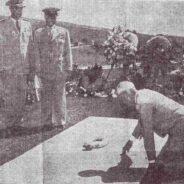
On October 21, 1953, a memorial ceremony was held at the National Memorial Cemetery of the Pacific at Punchbowl in Honolulu to mark the mass burial of 178 Americans killed on Wake Island in World War II. Fourteen marine survivors attended, as well as some family members of the deceased and officials and dignitaries. An actual recording of the Wake mass grave dedication ceremony has recently become available at the AFRTS Archive website. See end of this post for more information on the recording. The late morning sun bore down on the...
read moreEscape
Watching the Wake Island episode of Oliver North’s 2005 series “War Stories” last week, I was reminded of Brigadier General John F. Kinney’s heroic escape story. Very few POWs attempted escape from Japanese camps in WWII, and fewer still succeeded. For those interned in Japan proper escape was inconceivable, but in Japanese-occupied territories outside the homeland there was a slim chance of success. Physical escape was the least of the challenges: safe movement and connection with friendly forces on the outside would be the deciding factors....
read moreEnglish Plurals
I found the following poem on the oddities of English plurals in our local newspaper today. According to the columnist, the poem’s origin is obscure: it showed up in newspapers in the late 19th century and more recently in “Crazy English,” by Richard Lederer. It’s just the sort of thing that my father and those other “hard hat poets” on Wake Island would have loved. So here, apropos of nothing, is “Ode to English Plurals.” We’ll begin with a box, and the plural is boxes, but the plural of...
read moreJPAC Wake Island Mission

In 2011, a worker discovered a group of human remains exposed on the north beach of Wake Island near the site where American POWs were massacred in October 1943. The Joint POW-MIA Accounting Command (JPAC) sent a team to Wake to recover the remains and excavate the site. JPAC opened a mission to identify the remains and I volunteered to locate families of the “Wake 98” to provide DNA reference samples to aid in identification. While the majority of the massacre victims’ remains are interred in the mass grave in Punchbowl Cemetery, none were...
read moreHonor Flight
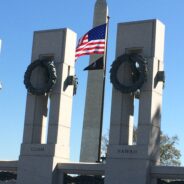
There is no better way to visit the war memorials in Washington D.C. than in the company of our nation’s war veterans. I went on the Inland Northwest Honor Flight to D.C. on October 8-9 as a volunteer “guardian” and was deeply moved many times during the trip. It was my good fortune to be matched with two fine gentlemen whose perspectives and memories gave special meaning to the experience. The dedication of the national World War II memorial in 2004 spurred the organization of the Honor Flight network. A retired USAF officer and physician...
read moreThe Railway Man

The Railway Man is the story of an ordinary man whose horrific experiences as a POW left him emotionally crippled for decades after the war until he confronted and ultimately forgave the target of his old, deep hatred. Thousands of ex-POWs, including my father, shared the first part of that sentence; very few were willing or able to achieve the second part. Eric Lomax’s journey reveals the dark world of intentionally buried horrors and shows us that there is – to use his favorite railroad metaphor – a light at the end of the tunnel. Eric...
read more